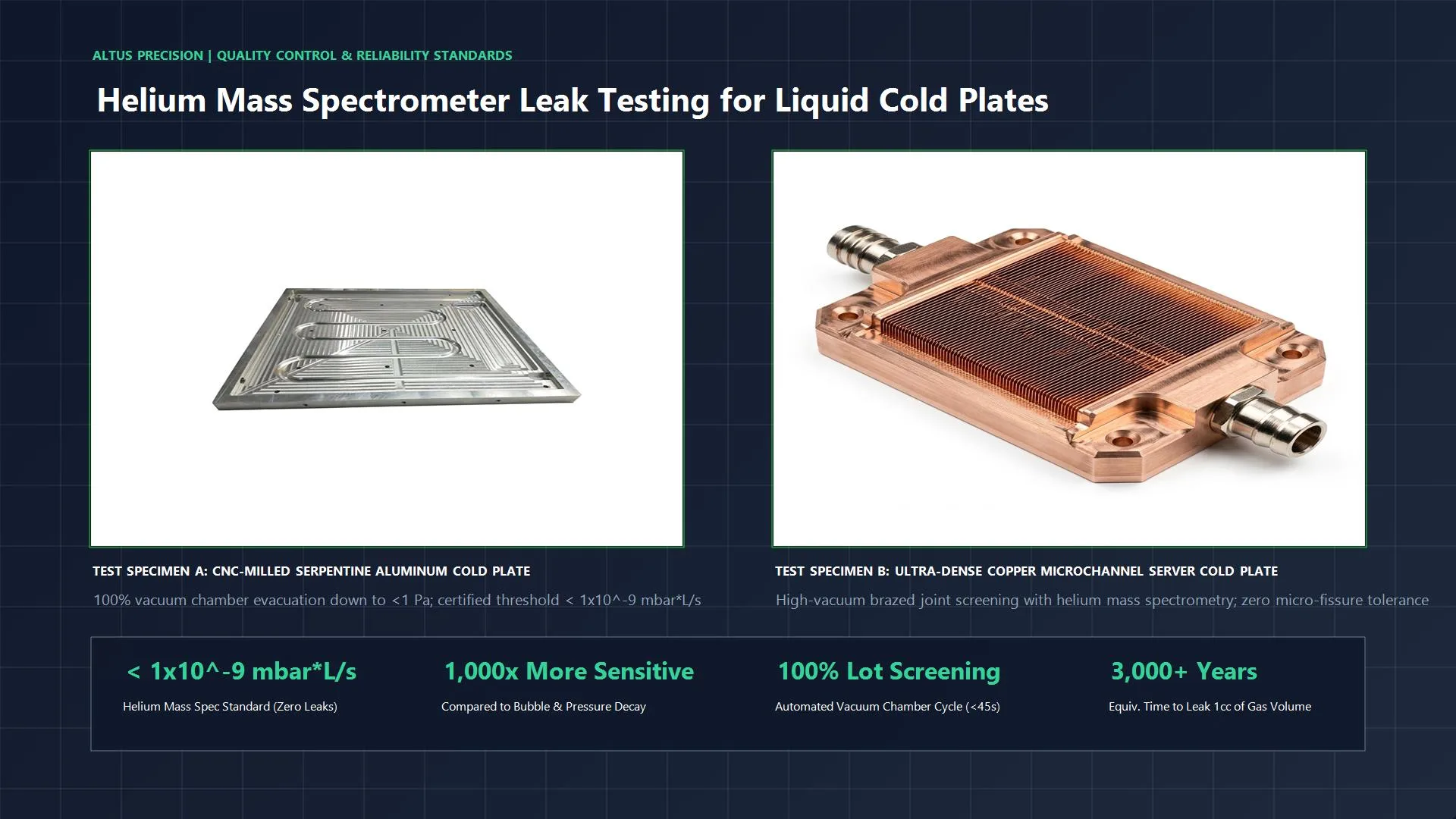
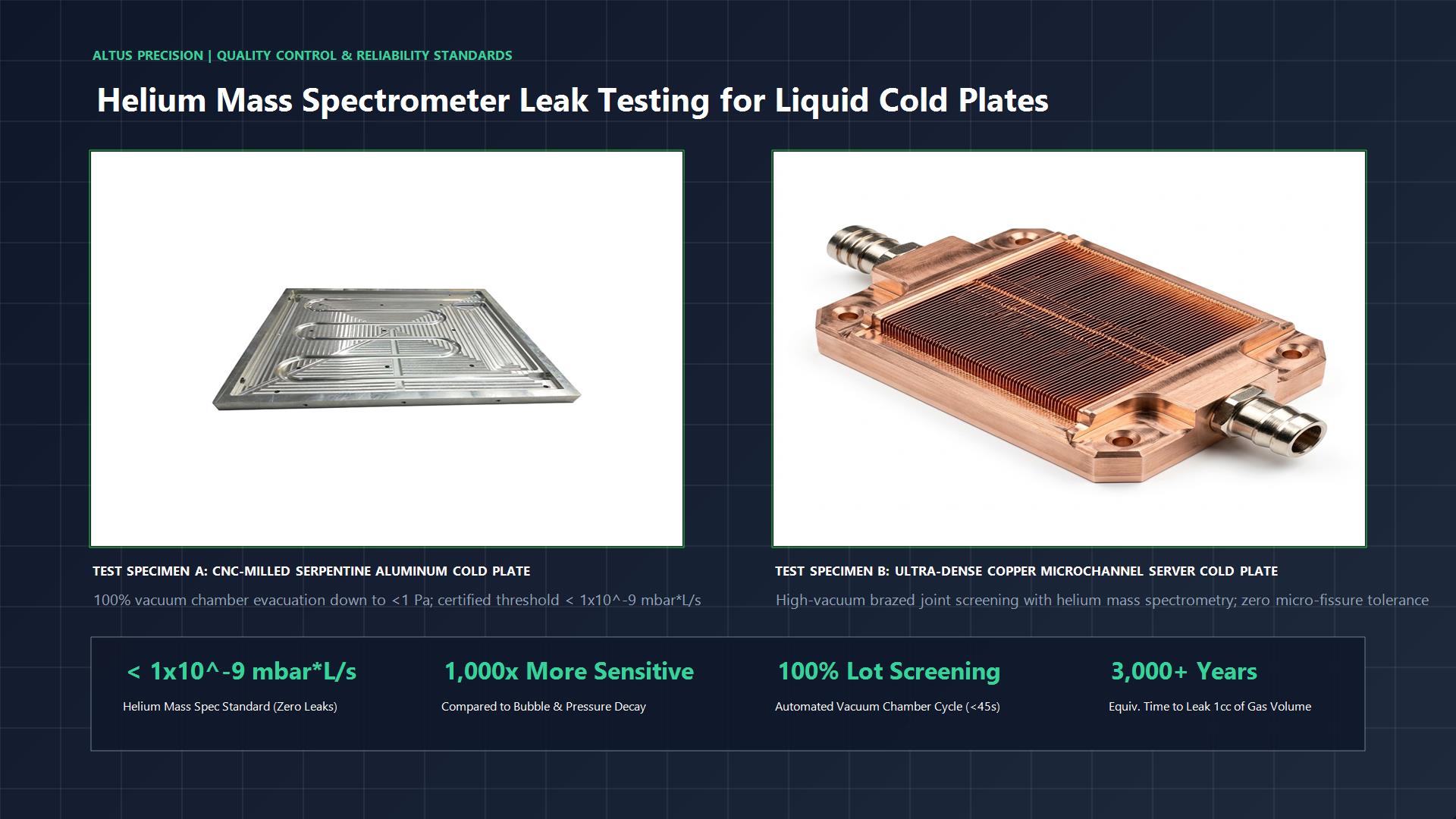
Helium Mass Spectrometer Leak Testing for Liquid Cold Plates: Meeting 1Ã10â»â¹ mbar·L/s Standards
Executive Engineering Summary: In mission-critical liquid cooling systemsâincluding 1000W+ AI server clusters, high-frequency trading rigs, and 800V electric vehicle battery packsâcoolant leakage is the single most catastrophic failure mode. A single droplet of water-glycol coolant on live high-voltage electronics causes immediate short circuits, galvanic arc flashes, and millions of dollars in downtime. Yet, many tier-2 fabricators rely on rudimentary bubble water submersion or pressure decay testing, methods fundamentally incapable of detecting micro-fissures below 10-3 to 10-4 mbar·L/s. This quality engineering guide details why Helium Mass Spectrometer Leak Testing inside an automated high-vacuum chamber is the definitive global standard for cold plate leak testing, how Altus Precision guarantees certified leak rates below 1 × 10⁻⁹ mbar·L/s (equivalent to less than 1 cubic centimeter of gas escaping over 3,000 years), and how hardware procurement teams can audit leak test certificates to eliminate liability.
1. The Zero-Leak Imperative: The Cost of a Single Micro-Droplet
In air-cooled datacenters or traditional industrial machinery, minor hydraulic dampness along a fitting is often considered a minor maintenance annoyance. In modern high-density compute and electrified powertrains, there is zero tolerance for fluid egress:
- Server Rack Catastrophe: A modern AI server rack (e.g., NVIDIA NVL72 or OCP ORv3) draws up to 120 kW of electrical power and hosts hardware valued at 3,000,000$ to $$4,500,000$. Liquid cold plates sit directly above bare silicon dies, 800G optical transceivers, and high-density power distribution boards. A slow micro-drip can accumulate unnoticed beneath thermal insulation pads until it bridges high-amperage 48V or 12V power rails, triggering explosive arc faults.
- EV Battery Fire Risk: In commercial electric vehicles, liquid cooling plates operate directly adjacent to 800V lithium-ion cell terminals. Coolant fluid leaching into the pack environment degrades dielectric isolation resistance (<100 Ω/V), initiating thermal runaway and total vehicle loss.
- Thermal Cycle Micro-Fissure Propagation: Liquid cold plates undergo thousands of thermal power cycles (-40^°C ≤ftrightarrow +85^°C) and mechanical hydraulic pulsation shocks. A microscopic manufacturing void in a brazed or welded joint that shows no visible leak during a quick factory bubble dip will gradually propagate under cyclic fatigue, turning into an active leak months after deployment.
2. Why Conventional Leak Testing Methods Fail
Low-cost manufacturing shops often claim their cold plates are "100% leak tested" because they dipped the assembly in a warm water tub or hooked it up to a digital pressure gauge. However, fluid physics demonstrates why these methods leave electronics exposed to catastrophic latent leaks.
Bubble Water Immersion
- Surface Tension Barrier: For micro-fissures <10µm, water's surface tension prevents air bubble formation.
- Human Operator Fatigue: Staring into a water tank for 5 minutes misses intermittent microscopic bubbles.
- Sensitivity Floor: Max limit of ~10â»Â³ mbar·L/s. Cannot detect slow fluid weepage.
Pressure Decay (Air/Nâ)
- Adiabatic Thermal Drift: Ambient temperature shifts of just 1°C skew pressure by ~3.5 kPa, masking micro-leaks.
- Internal Volume Limit: In large cold plates with large internal volumes, tiny pressure drops are lost in gauge noise.
- Sensitivity Floor: Realistic shop limit of ~10â»â´ mbar·L/s. Blind to micro-porosity.
Vacuum Chamber Helium MS
- Sub-Nanometer Kinetic Diameter: Helium molecules (0.26 nm) penetrate any defect that liquid can ever pass through.
- Atmospheric Independence: High-vacuum chamber eliminates ambient drift and operator subjectivity.
- Sensitivity: < 1Ã10â»â¹ mbar·L/s (1,000 to 100,000x more sensitive).
3. The Physics of Helium Mass Spectrometry
Why is helium (4He) the universal tracer gas for mission-critical leak detection?
- Tiny Molecular Kinetic Diameter (0.26 nm): Helium is the smallest monoatomic gas molecule aside from hydrogen. Any microscopic crack, braze void, or grain boundary micro-fissure capable of leaking water-glycol coolant (0.45 nm molecular size) will allow helium gas to pass through with zero hydraulic resistance.
- Chemically Inert & Safe: Unlike hydrogen, helium is 100% non-flammable, non-toxic, and non-corrosive, leaving no chemical residue inside internal microchannels.
- Ultra-Low Ambient Concentration (5 ppm): Atmospheric air contains only 5 parts per million of natural helium. This negligible background allows the mass spectrometer to detect minute quantities without false positives.
The Detection Mechanism: Magnetic Sector Mass Filter
Inside the helium leak detector:
- Gas molecules drawn from the test chamber are ionized by a hot tungsten/rhenium filament into positive ions (He+).
- The ions are accelerated through an electrostatic field and focused into a curved magnetic sector.
- Because magnetic deflection depends strictly on the mass-to-charge ratio (m/z), helium ions (m/z = 4) follow an exact radius of curvature, striking a Faraday cup collector plate while heavier molecules (N2, O2, H2O) hit baffle walls and are rejected.
- The collected ion current is converted into an electrical signal directly proportional to the volumetric leakage rate (Qleak).
4. Testing Methodologies: Hard Vacuum Chamber vs. Sniffer Testing
Not all helium testing is created equal. There are two primary techniques used in the industry:
5. Leak Rate Mathematics: Translating 1 × 10⁻⁹ mbar·L/s into Real-World Fluid Loss
Procurement managers often ask: "What does 1 × 10⁻⁹ mbar·L/s mean in actual coolant loss over the 5-to-10 year service life of a server rack?"
The standard leak rate (Q) is defined as the pressure-volume product per unit time:
Because water-ethylene glycol (WEG) has a dynamic viscosity (>2.5 cP) roughly 130 times higher than helium gas, a microchannel crack that leaks helium at 1 × 10⁻⁹ mbar·L/s is physically impassable to liquid molecules under standard operating pressures.
6. The Altus Precision Dual-Stage Non-Destructive Quality Assurance Protocol
To deliver complete, warrantable zero-leak reliability, Altus Precision subjects 100% of liquid cold plate production to our integrated two-stage QA protocol:
Hydrostatic Overpressure Soak
- Pressure: 1.5x to 2.0x working pressure (e.g., 2.5 MPa / 25 bar).
- Duration: 15 to 30-minute hold time.
- Purpose: Validates structural joint shear strength, stress-relieves brazed assemblies, and verifies zero mechanical plastic deformation.
Automated Vacuum Chamber Helium MS
- Vacuum Level: Test chamber evacuated to <1 Pa (<10â»Â² mbar).
- Gas Charge: Internally charged with 99.999% pure Helium at 0.5â1.0 MPa.
- Certification: Rejects any part exhibiting aggregate leak rate ≥ 1×10â»â¹ mbar·L/s.
7. Procurement Audit Guide: How to Validate Helium Test Certificates
When qualifying an overseas precision manufacturing partner for liquid cooling components, procurement and quality directors should look beyond a generic stamp that reads "Leak Tested: OK".
Mandatory Verification Checklist for Helium Test Reports:
- Calibrated Reference Leak Artifact: Does the report state the serial number and calibration date of the external quartz capillary reference leak (e.g., calibrated to 1.2 × 10⁻⁸ mbar·L/s traceable to NIST or CNAS)?
- Background Baseline Noise (Qbg): A valid vacuum test report must document the pre-test chamber background leak rate (Qbg ≤ 2 × 10⁻¹⁰ mbar·L/s). Without background suppression, small leaks are masked by ambient signal saturation.
- Helium Concentration & Soak Time: The test report must state the exact helium concentration (100% vs. 10% mixed tracer) and chamber dwell time (>15 seconds).
- 100% Serialized Traceability: Every Altus Precision cold plate is laser-etched with a unique DataMatrix 2D barcode tying the individual physical plate directly to its stored vacuum helium test curve.
8. Frequently Asked Questions (FAQ)
Q1: What is the maximum acceptable helium leak rate for datacenter liquid cold plates?
Answer: The Open Compute Project (OCP) and leading hyperscalers (including Microsoft, Google, and Meta) typically specify an aggregate leak rate threshold of < 1 × 10⁻⁶ mbar·L/s for rack-level assemblies, with component-level cold plates held to the stricter standard of $< 1 \times 10^{-8}\text{ to } 1 \times 10^{-9}\text{ mbar}\cdot\text{L/s}$. Altus Precision certifies every server cold plate to the rigorous < 1 × 10⁻⁹ mbar·L/s threshold.
Q2: Why must cold plates undergo hydrostatic testing BEFORE helium testing?
Answer: Hydrostatic testing applies mechanical stress to verify that brazed joints and weld roots possess adequate tensile and burst yield strength. Testing with helium after hydrostatic proofing ensures that mechanical micro-stretching or thermal expansion did not open hairline fissures along internal braze boundaries.
Q3: Can helium test results be falsified or skewed by "virtual leaks"?
Answer: Yes. "Virtual leaks" occur when gas trapped inside blind screw holes, porous casting pockets, or unvented O-ring grooves slowly outgasses under high vacuum. Altus Precision engineers internal flow paths with smooth DFM radii and blind-hole relief channels, and enforces a mandatory vacuum bake-out cycle to eliminate virtual leak anomalies.
9. Safeguard Your Liquid Cooling Deployment with Altus Precision
Do not let uncertified leak testing jeopardize multi-million-dollar AI infrastructure or high-voltage electric vehicle platforms.
Partner with Altus Precision for Certified Reliability:
- 100% In-Chamber Helium Mass Spectrometry: Certified leak rates below 1 × 10⁻⁹ mbar·L/s.
- Hydrostatic Burst Cell: Destructive pressure verification up to 15+ Bar (150+ MPa capabilities).
- ISO 9001 & Automotive Quality Control: 100% serialized laser barcoding and full CMM inspection reports.
- Fast-Track DFM Feedback: Full thermal, mechanical, and leak-testing feasibility reviews within 24 hours.
ð Submit your CAD files today to request a comprehensive DFM review and sample leak test certificate:
- Website: altusprecision.com
- Quality & Engineering Team:
info@altusprecision.com - Request Cold Plate DFM & Leak Test SOP: Upload CAD Drawings