Aluminum 6061 vs. 6063 for Liquid Cold Plates: Balancing Thermal Conductivity, Strength, and Brazing
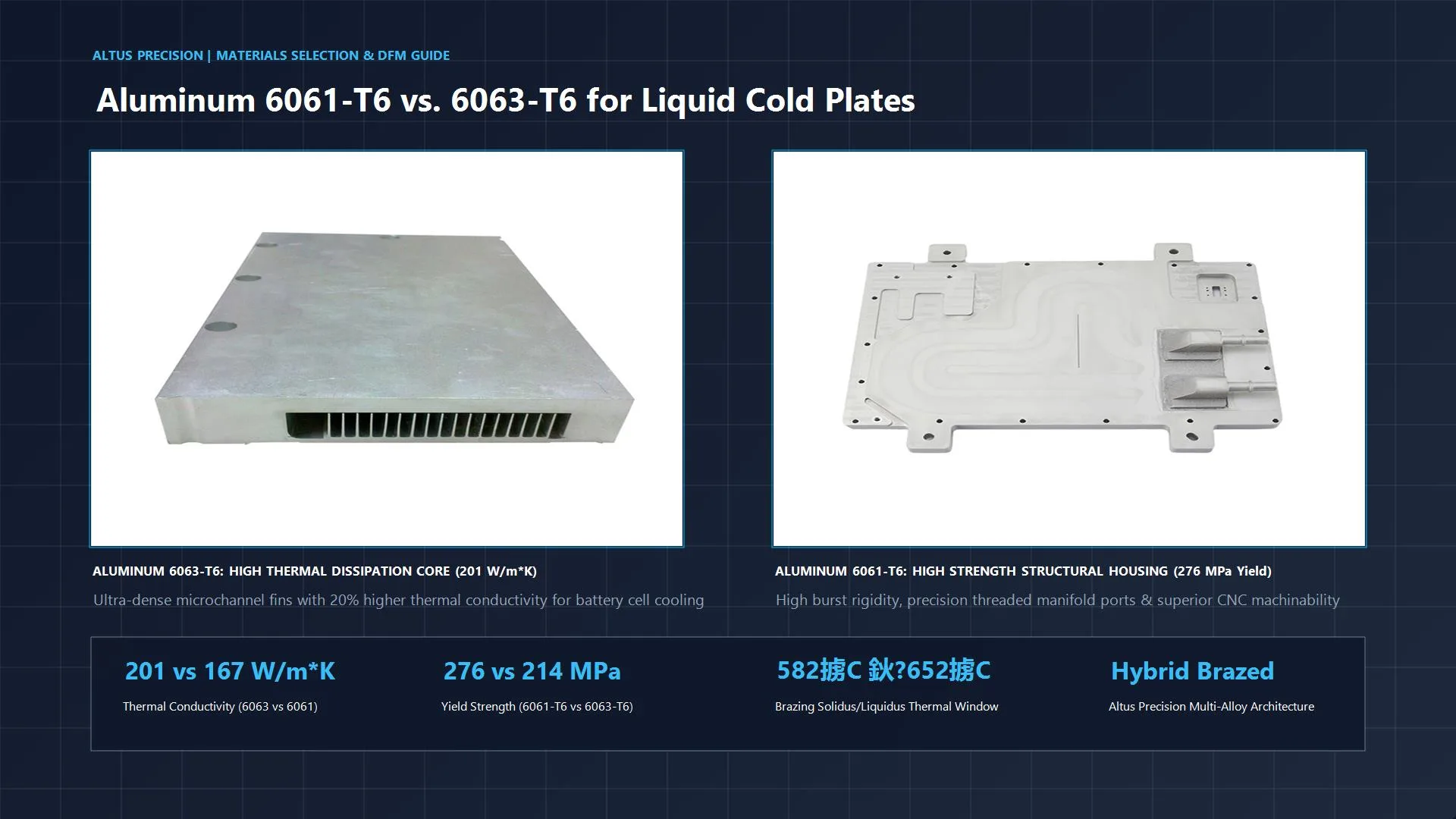
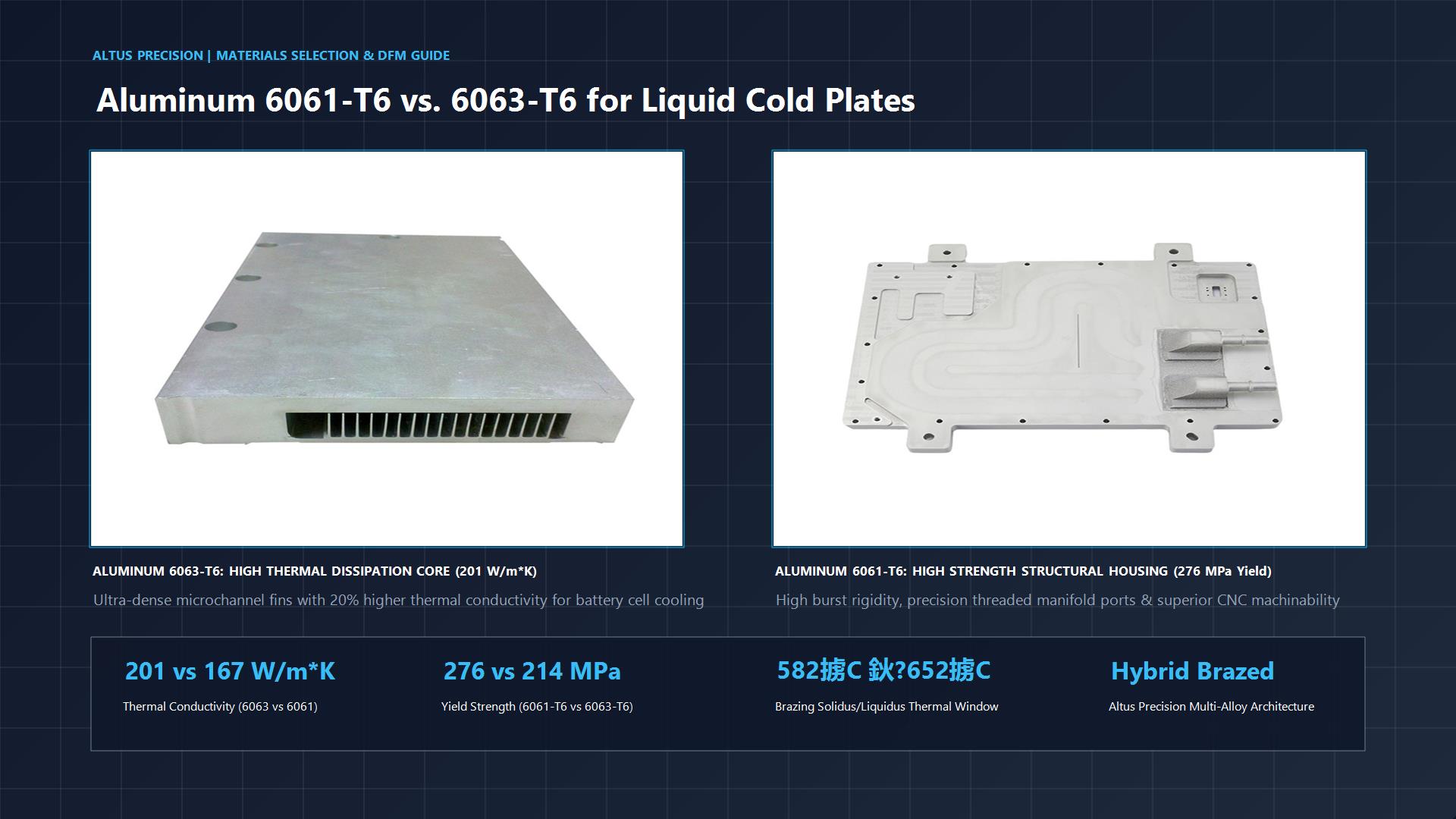
Executive Engineering Summary: When designing a custom aluminum cold plate for high-heat-flux power electronics, EV inverters, or telecommunication chassis, thermal architects face a classic trade-off: thermal conductivity versus mechanical rigidity. While Aluminum 6063 delivers superior heat dissipation with a thermal conductivity of ≈ 201 W/(m·K) (~ 20% higher than 6061), its lower yield strength (214 MPa in T6 temper) limits internal fin aspect ratios and structural thread strength. Conversely, Aluminum 6061-T6 offers outstanding mechanical yield strength (276 MPa), high hydraulic burst tolerance, and excellent 5-axis CNC machinability, but compromises thermal spreading with a lower conductivity of ≈ 167 W/(m·K). This comprehensive materials guide breaks down the metallurgical, thermodynamic, vacuum brazing, and DFM considerations between both alloysâand introduces Altus Precision's hybrid brazed architecture combining 6063 skived microchannels with a 6061 structural housing.
1. Introduction: The Metallurgy of Aluminum Liquid Cold Plates
In modern liquid cooling architectures, aluminum is the indisputable material of choice for high-volume automotive, aerospace, and industrial electronics. Weighing only one-third of copper (ρAl ≈ 2.70 g/cm3 vs. ρCu ≈ 8.96 g/cm3) while delivering over 50% of copper's thermal conductivity at a fraction of the raw material cost, aluminum delivers the optimal gravimetric thermal efficiency (W/(kg·K)).
However, selecting the specific 6000-series alloyâspecifically Al 6061 versus Al 6063âdictates virtually every downstream manufacturing and thermal parameter:
- Thermal Dissipation: Maximum heat transfer coefficient (h) through internal cooling channels and overall thermal resistance (Rth, j-f).
- Hydraulic Rigidity: Internal pressure capability, resistance to cyclic water hammer (0 ≤ftrightarrow 1.5 MPa pulses), and maximum burst safety factor.
- Vacuum Brazing Window: Solidus and liquidus temperatures relative to Al-Si eutectic brazing filler alloys (577^°C-595^°C).
- Machinability & Fin Pitch: Tool deflection during microchannel slotting or high-aspect skiving.
2. Chemical Composition & Thermodynamic Properties
Both 6061 and 6063 are precipitation-hardened aluminum-magnesium-silicon (Al-Mg-Si) alloys. Their physical divergence stems from precise alloying proportions:
- Al 6061 ("Structural Aircraft Aluminum"): Contains higher magnesium (0.8%-1.2%) and silicon (0.4%-0.8%), along with intentional additions of copper (0.15%-0.40%) and chromium (0.04%-0.35%). The copper content increases precipitation hardening kinetics (Mg2Si and Al2CuMg phases), boosting mechanical tensile strength at the direct expense of thermal conductivity and galvanic corrosion resistance.
- Al 6063 ("Architectural / Thermal Aluminum"): Contains roughly half the alloying content (0.45%-0.90% Mg, 0.20%-0.60% Si), with virtually zero copper (<0.10%). The cleaner aluminum matrix minimizes electron-phonon lattice scattering, allowing heat to conduct freely through the crystalline lattice.
3. Thermal Dissipation & CFD Simulation Impact: 201 vs. 167 W/(m·K)
Does a 34 W/(m·K) difference (20.4%) in thermal conductivity translate into meaningful real-world temperature reductions? The answer depends heavily on your cold plate's heat flux regime and aspect ratio.
3.1 Low Heat Flux Applications (<25 W/cm²)
In broad-area heat sources, such as EV battery pack bottom chill plates or large telecom RF power amplifier heatsinks (q'' < 25 W/cm2), the heat path is predominantly 1-dimensional conduction across a thin 1.5 mm-3.0 mm baseplate into the fluid channels.
- In this regime, convective fluid boundary layer resistance (Rconv = 1/(h· A)) accounts for >70% of total thermal impedance.
- Upgrading from 6061 to 6063 drops junction temperature (Tj) by only 0.8^°C to 1.5^°C. Here, structural strength or cost often outweighs thermal gains.
3.2 High Heat Flux & Fin Conduction Applications (>60 W/cm²)
In concentrated heat sources (IGBT traction inverters, SiC MOSFET power modules, and server CPU/GPU sockets) where heat flux exceeds 60 W/cm2 to 120 W/cm2, fin efficiency (ηf) becomes the dominating thermal bottleneck:
4. Mechanical Rigidity, Hydraulic Burst & Thread Fatigue
Where Al 6063 excels in heat transfer, Al 6061 dominates structural integrity.
MECHANICAL YIELD STRENGTH COMPARISON (T6 TEMPER)
Al 6061-T6  [========================================] 276 MPa (Superior Burst Rigidity)
Al 6063-T6  [===============================] 214 MPa (-22.5% Lower)
Pure Al 1060 [====] 28 MPa (Unusable for Pressurized Loops)
4.1 Internal Burst Pressure Resistance
Under automotive testing standards (such as USABC or LV 124), battery cold plates must survive cyclic hydraulic pressure pulsations (0 → 1.0 MPa at 1 Hz for 100,000 cycles) and maintain a minimum burst safety factor ≥ 2.5× to 4.0× working pressure.
- Deflection Under Working Pressure: With a 29% higher yield strength (276 MPa vs. 214 MPa), Al 6061 resists planar ballooning and bending deflection. A 6061 top cover sheet experiences 31% less mid-span elastic deflection than an equivalent thickness 6063 cover plate under 1.5 MPa proof pressure.
- Channel Partition Rib Stability: In cold plates with deep milled channels (>4 mm), 6061 ribs resist tensile pull-off stresses during hydrostatic surge spikes, preventing progressive fatigue delamination.
4.2 Manifold Port Thread Shear Strength
Liquid cold plates interface with the vehicle or rack cooling loop via threaded fluid fittings (G-thread, NPT, or SAE J1926 O-ring boss ports).
- Al 6063 has a lower shear strength (≈ 152 MPa) and surface hardness (73 HBW). Repetitive torquing of steel quick-disconnect couplings (QDCs) can strip internal threads or induce galling.
- Al 6061 has a shear strength of 207 MPa and hardness of 95 HBW, providing over 36% higher thread pull-out resistance, making it the mandatory standard for wetted fluid manifolds and external mounting brackets.
5. Vacuum Brazing & DFM: The 582°C Thermal Window Crisis
For mission-critical assemblies requiring zero-leak reliability, High-Vacuum Brazing (HVB) is the gold-standard joining technique. However, brazing 6061 versus 6063 presents vastly different metallurgical risk profiles.
Post-Braze Heat Treatment (T6 Recovery)
Both 6061 and 6063 emerge from the vacuum brazing furnace (590^°C) in a fully annealed, dead-soft "O" temper condition (σy < 80 MPa). To restore design strength, cold plates must undergo post-braze heat treatment:
- Solution Heat Treatment (SHT): Soak at 520^°C-535^°C for 60 minutes.
- Rapid Quench: Controlled water or pressurized nitrogen quench to freeze alloying elements in solid solution.
- Artificial Aging: Age at 160^°C-175^°C for 8 to 12 hours to precipitate fine Mg2Si needles, returning the base metal to T6 temper.
Because Al 6063 contains less magnesium and copper, it exhibits lower quench sensitivity. In thin sections, 6063 can achieve near-T6 strength simply through high-velocity nitrogen gas quenching directly inside the vacuum furnace chamber, avoiding distortion caused by violent liquid water quenching.
6. CNC Machinability, Skiving & Surface Finishing
6.1 CNC Milling vs. Skived Fin Density
- CNC Micro-Milling (Al 6061 Advantage): Al 6061 produces tight, discontinuous chips that evacuate easily during high-speed CNC milling (18,000-24,000 RPM). It achieves mirror surface finishes (Ra < 0.4 μm) and holds dimensional tolerances down to pm 0.015 mm without gummy burr buildup along channel edges.
- Skived Fin Machining (Al 6063 Advantage): Skiving involves shaving thin, continuous metal slices from a solid billet and curving them upward at 90^° to form ultra-dense fin stacks. Al 6063's superior ductility and lower work hardening rate make it the undisputed king of skived fin fabrication:
- 6063 allows fin thicknesses down to 0.20 mm - 0.40 mm with aspect ratios exceeding 15:1 to 20:1.
- 6061 tends to tear, fracture, or chatter during micro-skiving due to its higher shear resistance.
6.2 Surface Treatment: Anodizing vs. Electroless Nickel Plating
- Hard Anodizing (Type III): Al 6063 produces an exceptionally uniform, crystal-clear or deep black oxide coating (25 μm-50 μm, hardness >500 HV) due to its minimal copper content. Al 6061 can also be hard-anodized, but its copper content can produce a slightly grayish, mottled appearance.
- Electroless Nickel Immersion Gold (ENIG) / Plating: When aluminum cold plates must be connected into mixed-metal cooling loops (containing copper piping or brass fittings), internal channels must be plated with high-phosphorus (10%-12% P) electroless nickel to prevent galvanic corrosion. Both 6061 and 6063 plate readily following standard double zincate pre-treatment.
7. The Altus Precision Engineering Standard: The Hybrid 6063 + 6061 Brazed Architecture
Why compromise between thermal efficiency and structural strength when you can harness the strengths of both alloys?
At Altus Precision, our thermal engineering team frequently designs and manufactures Hybrid Multi-Alloy Liquid Cold Plates:
Al 6063 Skived Microchannel Insert
- Thermal Conductivity: 201 W/(m·K).
- Geometry: 0.3mm fin width, 0.4mm pitch, 15:1 aspect ratio.
- Function: Positioned directly beneath high-heat-flux silicon or IGBT modules for maximum heat absorption.
Al 6061-T6 CNC Milled Manifold Housing
- Yield Strength: 276 MPa.
- Features: CNC-threaded fluid ports (SAE/G-thread), mounting bosses, O-ring sealing perimeter.
- Function: Delivers 4.0+ MPa burst pressure resistance and rigid chassis mounting.
8. Frequently Asked Questions (FAQ)
Q1: Can Al 6061 and Al 6063 be vacuum brazed together in the same assembly?
Answer: Yes, absolutely. Al 6061 and Al 6063 are completely metallurgically compatible because they share the same Al-Mg-Si base alloy system. When using an Al-Si 4004 or 4343 brazing filler alloy (577^°C-592^°C), the vacuum furnace temperature profile must be controlled within pm 2^°C to stay below 6061's solidus (582^°C) while fully melting the braze clad. Altus Precision regularly vacuum brazes hybrid 6063 fin inserts into 6061-T6 structural housings with zero void formation.
Q2: When is copper still required instead of Aluminum 6063?
Answer: While Al 6063 provides impressive thermal performance (201 W/(m·K)), copper C11000/C10100 (388-391 W/(m·K)) is required when localized silicon heat flux exceeds 100 W/cm2 to 150+ W/cm2 (such as modern AI accelerators like NVIDIA H100/B200), or when the allowable thermal resistance budget (Rth) is so compressed that the bulk conduction resistance of aluminum causes junction temperatures to overshoot maximum thermal specs.
Q3: Why not use pure aluminum (like 1060 or 1070) for the cold plate base?
Answer: Pure aluminum alloys (1000-series) offer even higher thermal conductivity (230-234 W/(m·K)), but they possess virtually zero mechanical strength (σy ≈ 28-35 MPa). A cold plate made from 1060 will balloon and rupture at modest fluid pressures (<0.8 MPa), cannot retain threaded fluid fittings, and is excessively gummy to machine via CNC milling. 6063-T6 provides >85% of pure aluminum's conductivity while delivering over 7× higher yield strength.
Q4: What coolant additives are required to prevent corrosion in aluminum cold plates?
Answer: Untreated tap water or pure deionized water will pit aluminum over time. Aluminum liquid cooling loops require a 50/50 Water-Ethylene Glycol (WEG) or Water-Propylene Glycol (WPG) blend formulated with organic acid technology (OAT) corrosion inhibitors (such as silicates, sebacates, or azoles) that maintain fluid pH between 7.5 and 8.5 and passivate the wetted aluminum surface.
9. Optimize Your Cold Plate Material Strategy with Altus Precision
Are you finalizing material specifications for next-generation liquid cold plates or thermal management assemblies? Do not settle for guesswork between thermal performance and structural durability.
Altus Precision Capabilities:
- Comprehensive Alloy Selection: Precision machining and vacuum brazing in Al 6061-T6, Al 6063-T6, Pure Al 1060, and C10100 Oxygen-Free Copper.
- Microchannel & Skived Fin Tooling: Fin widths down to 0.20 mm with aspect ratios up to 15:1.
- Flux-Free High-Vacuum Brazing: Monolithic shear strengths >180 MPa at 10-5 mbar vacuum.
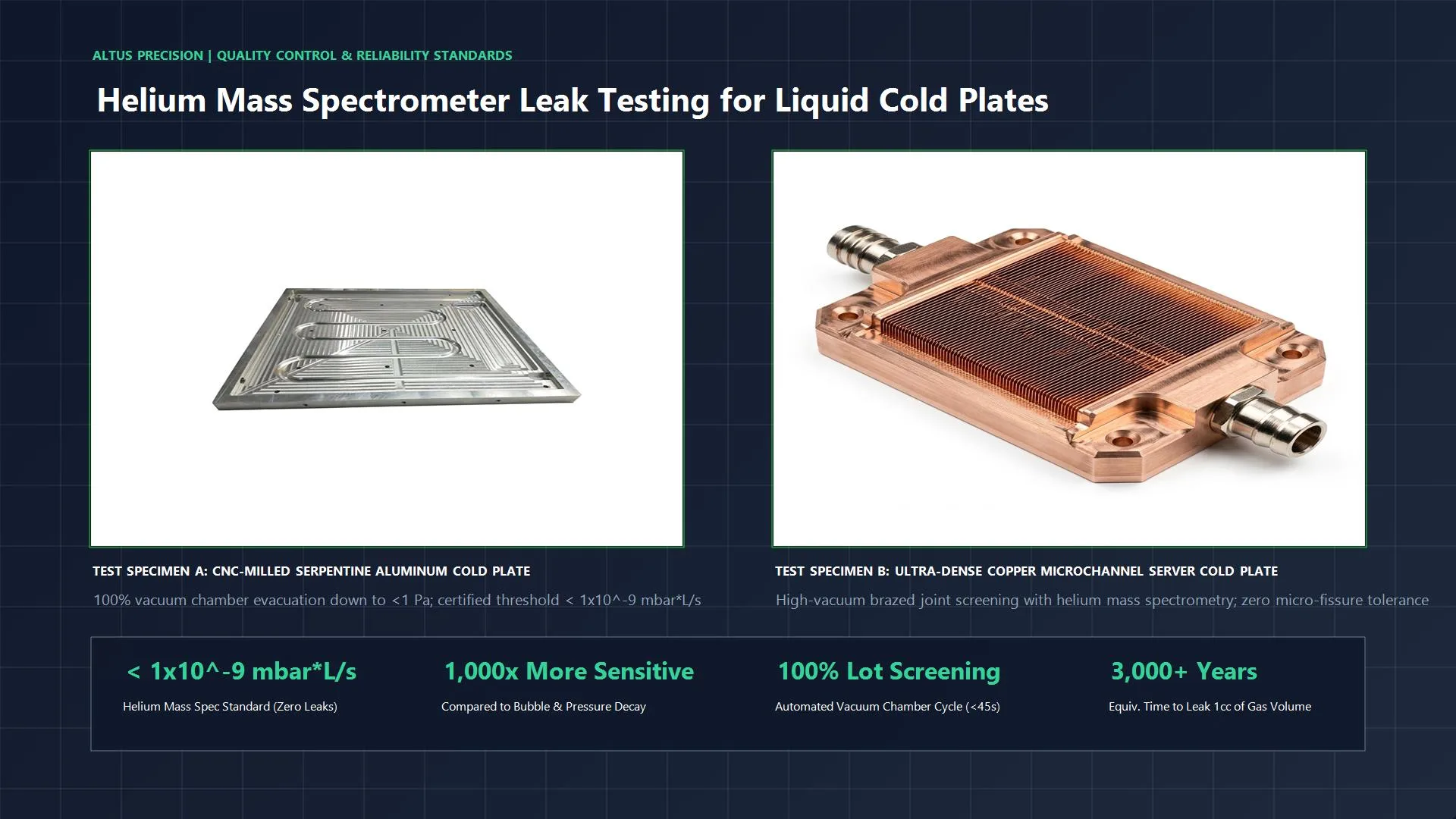
- 100% Quality Validation: CMM dimensional inspection, hydrostatic burst testing, and helium mass spec leak testing (<1× 10⁻⁹ mbar·L/s).
ð Submit your CAD drawings to our thermal engineering group today for a complimentary DFM and material optimization review:
- Website: altusprecision.com
- Engineering Support:
info@altusprecision.com - Request DFM & Material Review: Upload 3D CAD Files