CNC machining is a subtractive manufacturing process in which a computer-controlled cutting tool removes material from a solid block until the part matches a 3D model. If a supplier has just sent you a drawing or a quote, and you are still working out what is CNC machining and why the numbers look the way they do, this guide follows the chain from CAD file to inspected part.
Most newcomers meet the process mid-conversation. A supplier asks whether the part is turned or milled, a colleague mentions 5-axis, and the quote lists setup and programming as separate lines. Each of those terms maps to a decision you control, and each one moves the price.
Key Takeaways
CNC machining cuts material away with a programmed tool. It wins when geometry, repeatability and real material properties matter more than the speed of the first article.
Programming, setup and fixturing are one-time costs per job. Cycle time and material are the blocks that scale with quantity.
Tolerance and surface finish are the two biggest cost levers in any quote, and beginners over-specify both more often than any other line.
The drawing drives every downstream decision, so it is worth finishing before you shop on price.
Ask whether the quote includes first article inspection, and which tolerance, finish and inspection level it assumes.
What Is CNC Machining, and Where Does It Fit in Manufacturing?
The letters stand for computer numerical control. A programmer converts your 3D model into a toolpath, that toolpath becomes G-code, and the machine follows those coordinates to cut material away.
Nothing is moulded, pressed or printed here. The final shape comes from what has been removed.
That subtractive logic shapes the economics. Setup effort is front-loaded, because someone has to program the part, mount the stock and prove the first piece. Once the machine is running, each extra part is cheap by comparison. It explains why a single prototype feels expensive and the tenth or hundredth unit usually does not.
In most CNC jobs the real cost sits in proving the setup, not in the parts that follow it.
Use these four tests to decide quickly whether your part belongs on a machining centre. If you answer yes to two or more, CNC is usually the right conversation to have.
Tolerance demand: features must mate with something else and hold position across a production run.
Material requirement: the part needs a specific alloy or temper, not a substitute that only approximates it.
Geometric complexity: internal pockets, cross-holes or compound angles that forming and printing cannot hold.
Quantity band: somewhere between a handful and a few thousand parts, where setup cost spreads but dedicated tooling cannot be justified.
Flip the tests and the answer flips too. Large flat panels, thin-walled shells and very simple parts at high volume belong in sheet metal, casting or moulding, where unit cost falls quickly with quantity. A good supplier will tell you that instead of quoting anyway; our sheet metal fabrication guide covers the crossover in more detail.
| Process | Best fit | Where it loses | Typical first choice for |
|---|---|---|---|
| CNC machining | Prismatic or turned parts with real material properties and tight tolerances | Large thin forms, very high volumes | Prototypes, fixtures, low to mid volume production |
| 3D printing | Complex internal geometry and fast design iterations | Material choice, finish and consistency at scale | Concept models and early prototypes |
| Sheet metal | Enclosures, brackets and panels from flat stock | Thick sections and machined mating features | Casings, chassis and mounting plates |
| Casting | Complex shapes at volume with generous tolerances | Tooling cost and lead time before the first part | High-volume housings and bodies |
How Does CNC Machining Work, From CAD File to Inspected Part?
Every job follows the same sequence, whether it is one bracket or a thousand cold plates. Knowing the sequence shows you where your input matters and where delays come from.
Model and drawing: 3D geometry plus tolerances, datums, finish callouts, material and any certification notes.
CAM programming: the programmer selects tools, workholding and cut order, then posts the G-code.
Setup and fixturing: stock is mounted, tools are measured, offsets are set and the first piece is proven.
Roughing and finishing: most of the material comes off fast, then slower passes bring the part to tolerance.
Deburr and surface treatment: edges are cleaned up, then anodising, passivation or plating is applied.
Inspection: dimensions are checked against the drawing, often on a CMM, and the results are documented.
Programming and setup are one-time costs per job. Cycle time is the block that scales with quantity, and it scales with how much material has to be removed.
A part designed with less stock removal is cheaper at every volume. Design decisions quietly set the price floor.
The drawing drives everything downstream. A missing datum, an ambiguous note or a finish callout with no Ra value will come back as a question, and questions cost calendar time rather than money. Buyers often blame the shop for a week of delay that started with an incomplete drawing.
First article inspection exists to prove the setup before the rest of the run continues. Ask whether FAI is included, what gets documented, and whether you receive the report. On a first order with a new supplier, the answer tells you more than the price does.
CNC Milling vs CNC Turning vs 5-Axis: Which Process Does Your Part Need?
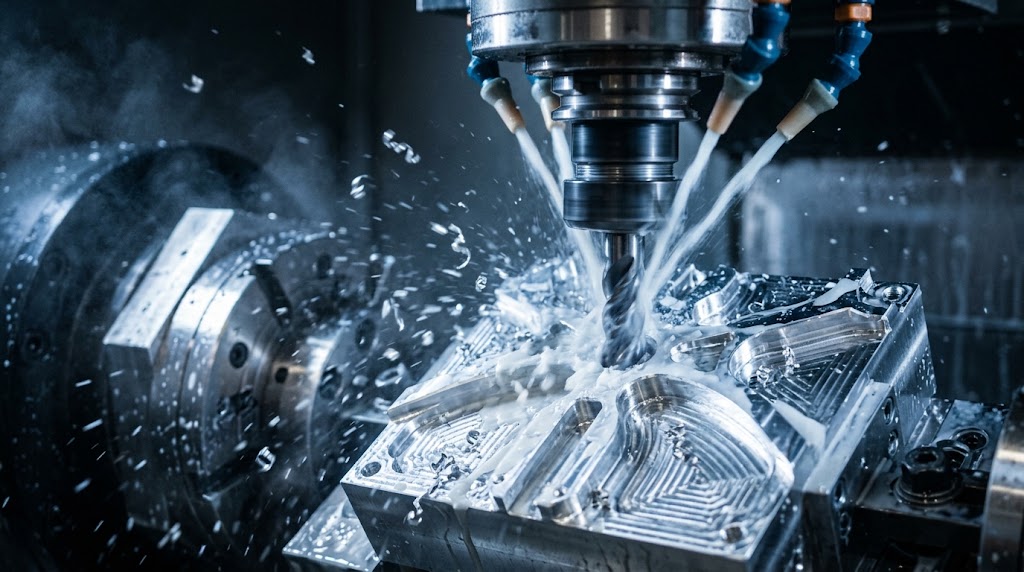
Milling cuts with a rotating multi-flute tool while the spindle moves through the workpiece. Turning does the opposite: the workpiece spins and a stationary tool removes material, which suits rotationally symmetric parts.
Your geometry usually picks the process for you before price enters the discussion.
Axis count decides how many setups the part needs. Three axes handle prismatic parts machined from one or a few sides. A fourth adds an indexing rotation. Five axes let the tool approach at compound angles, so undercuts and angled faces are finished without re-fixturing.
| Process | Best-fit geometry | Typical trade-off | When the extra cost is justified |
|---|---|---|---|
| 3-axis milling | Plates, brackets and housings machined from one or a few faces | A new setup for each additional face | Simple parts and tight budgets |
| 4-axis milling | Parts with features on several sides around one axis | Indexing adds setup time | Shafts with flats, manifold blocks |
| 5-axis milling | Compound angles, undercuts and deep features reachable in one setup | Higher hourly rate and more programming | Complex parts where one setup protects accuracy |
| CNC turning | Pins, sleeves, fittings and other round parts | Off-axis holes need a second operation | High-volume round components |
| Mill-turn | Turned bodies with cross-holes, flats or milled pockets | Fewer shops offer it, programming is heavier | Valve bodies, sensor housings, fluid fittings |
Five axes is not automatically better. It earns its rate when one setup protects the relationship between features, or when the part simply cannot be reached any other way. The same reasoning sits behind 5-axis micro machining for semiconductor tooling, where small features and compound geometry make re-fixturing a quality risk.
Mill-turn deserves a mention for anyone designing fluid or sensor hardware. When a part has turned features plus cross-holes or flats, doing both on one platform removes a second operation, a second setup and the tolerance stack that comes with it.
Why Tolerances and Surface Finish Drive the Price
Tolerance and finish are the two specifications that can double a quote without changing the drawing's outline by a millimetre.
Understanding what each one demands from the shop is the fastest way to stop overpaying.
Tolerance is a functional decision
A tighter tolerance means more operations, slower feeds, more frequent in-process checking, and sometimes a different machine entirely. Cost rises steeply rather than linearly, because the shop is buying certainty, not just accuracy.
The most common beginner over-specification is a blanket tolerance note applied to every dimension. Call out tolerance only where the function requires it. A mounting face needs control; a clearance edge usually does not, and saying so can take real money out of the quote.
Surface finish is a separate callout
Finish is specified independently of dimensional tolerance. A part can be dead on size and still fail a finish requirement, so the two cannot be traded against each other. Ra values, sealing faces and cosmetic zones all push the shop toward different tooling and passes; our surface roughness chart explains how the numbers map to machining cost.
| Requirement tier | What the shop must change | Cost direction |
|---|---|---|
| General | Standard tooling, normal feeds, spot checks | Baseline |
| Moderate | Extra finishing pass, more frequent in-process measurement | Modest increase |
| Tight | Slower feeds, temperature control, different machine, more inspection | Steep increase |
| Ultra-tight | Special processes, hand work, dedicated metrology, possibly a different shop | Highest, and some shops will decline to quote |
Datums deserve the same discipline. Pick the surfaces the part actually locates on in assembly, and make them machinable. Datum schemes borrowed from a CAD model rather than from how the part is used are a quiet source of inspection disputes.
Material Choice: How Aluminum, Titanium and Copper Change the Math
Material selection is a machining-cost decision as much as a performance decision.
The same geometry can be a comfortable job in 6061 aluminum and a slow, tool-hungry one in grade 5 titanium.
Aluminum grades machine quickly, hold a good finish and are widely stocked, which is why they dominate prototype and enclosure work. Titanium delivers strength and heat resistance but cuts slowly, wears tooling and stretches cycle time. The cost impact sits in the machining as much as in the stock price, as our breakdown of titanium versus aluminum machining economics shows.
Copper and high-conductivity alloys get chosen for thermal or electrical duty. Their gummy behaviour complicates chip control and finish, so cycle times and scrap rates look different from aluminum. If you are weighing grades for a cold plate or busbar, the comparison of C10100 versus C11000 copper covers the practical differences.
Stock form matters as much as alloy. Plate, bar and extrusion carry different lead times, different scrap allowances and different fixturing options. Confirm availability before you freeze the design, because a beautiful part with no stock on the shelf is a schedule problem.
Design for Machining: The Rules Beginners Break Most Often
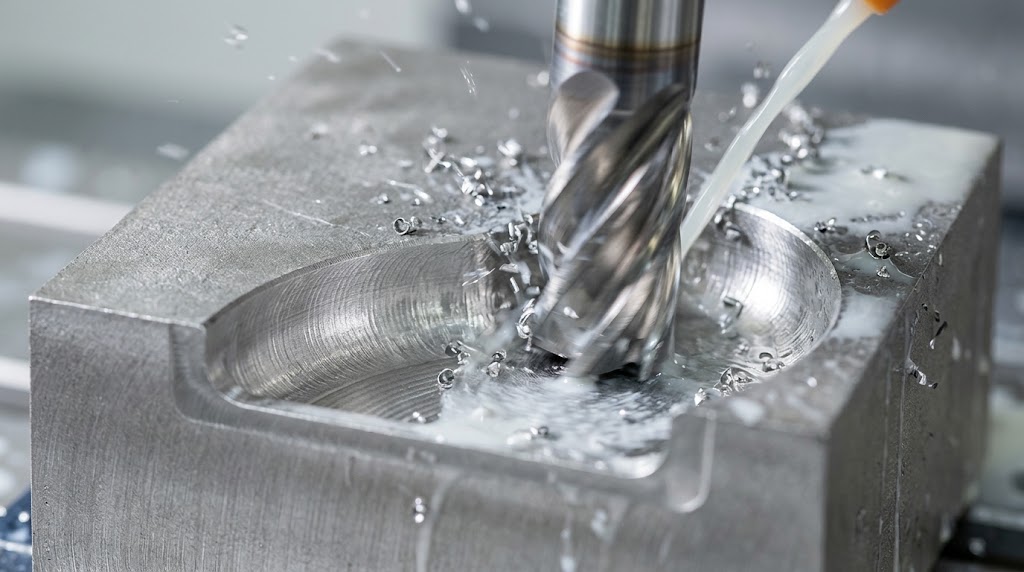
Design for manufacturing is mostly about respecting the tool. A cutter is a physical object with a diameter and a length, and every feature you draw has to be reachable by it.
Run this checklist over your model before you send it out.
Corner radii: an internal corner can only be as sharp as the cutter radius, so specify a radius the shop can actually reach.
Pocket depth: deep narrow pockets are limited by tool length-to-diameter ratio. If the tool cannot reach, the feature or the cost has to change.
Wall thickness: consistent walls cut chatter, deflection and rework. Sudden thin sections are where scrap comes from.
Datum and fixturing faces: leave a flat, accessible surface the part can be clamped on through roughing and finishing.
Stock size: match the part to a standard plate or bar size so you are not paying to turn good material into chips.
Deburr access: edges that cannot be reached by hand or tool will either cost extra or stay sharp.
In practice, most first submissions lose money on two items: pockets deeper than the cutter can comfortably reach, and corner radii drawn at zero. Both are visible in a few minutes of review, and both are cheap to fix in CAD.
What Are You Actually Paying For in a CNC Quote?
A quote is a stack of cost blocks, and the balance between them shifts with quantity. A one-off prototype is dominated by programming and setup. At volume, the same part is dominated by material and cycle time.
That shift explains why unit price moves so much when you change the order quantity.
| Cost block | What drives it up | How to reduce it |
|---|---|---|
| Material and stock allowance | Exotic alloy, thick plate, non-standard form | Right-size the stock and confirm availability early |
| CAM programming | Complex surfaces, many features, tight tolerances | Simplify geometry and reuse an existing design family |
| Setup and fixturing | Number of faces and setups, custom fixtures | Design so the part can be held in one or two setups |
| Machine cycle time | Hard material, heavy stock removal, tight tolerance | Remove less material and loosen tolerance where function allows |
| Finishing | Anodising, plating, polishing, masked areas | Specify a standard finish and drop cosmetic-only requirements |
| Inspection and documentation | FAI reports, CMM reports, material certificates | Ask what is standard before adding documentation |
| Packaging and freight | Export packing, sea freight, protective coating | Agree the packaging standard when the order is quoted |
A quote is only meaningful alongside the tolerance, finish and inspection level it assumes, so ask for those assumptions in writing.
Mismatched assumptions cause most later disputes. If the quote assumed a general tolerance and your drawing implies a tight one, the difference surfaces at inspection, not at order. Ask the supplier to state what they assumed, and you remove the argument before it starts.
Minimum order quantity works the same way. A shop that has to buy a full plate for four parts will either charge for the plate or decline the job. Asking about MOQ effects early keeps the comparison honest.
How to Vet a Machining Supplier Before Your First Order
Capability statements are marketing. Equipment lists, inspection reports and material traceability are evidence.
Spend your time on the second group, especially on a first order where you have no history to lean on.
Machine list: model, axis count and work envelope, so you can confirm your part fits and the tolerance is realistic.
Inspection equipment: a CMM, height gauge and surface tester tell you what can actually be measured and reported.
Material traceability: certificates on request, with heat or lot numbers that match the parts you receive.
First article process: a documented FAI report on request, not an informal check mentioned after the fact.
Packaging standard: protection, labelling and moisture control that suit your route and mode of transport.
Communication: who answers technical questions, and how quickly they respond during quoting.
For buyers sourcing overseas, add a layer for verification and payment terms. Our vetting guide for sourcing CNC parts from China walks through audits, sample orders and documentation checks that apply to any new supplier relationship, not just Chinese ones.
Where CNC Machining Fits in Your Next Build
The practical order of decisions is short. Confirm the part suits a subtractive process, pick milling or turning from the geometry, choose a material that is both functional and stocked, set tolerance and finish only where they earn their cost, then review the model against the tool rules before you send it.
What you get back is a quote you can read line by line and a supplier you can question with specifics.
That is the real benefit of understanding what is CNC machining at this level: fewer surprises at inspection, and less money spent on precision nobody asked for.
You can review the range of parts Altus produces in the CNC machined parts catalog, or send a drawing and a quantity for a quote with the assumptions stated up front.
- Is CNC machining subtractive or additive?
- It is subtractive. A rotating cutter removes material from a solid block until the part matches the model, whereas 3D printing adds material layer by layer.
- How does CNC machining work in simple terms?
- A programmer turns the 3D model into a toolpath, the toolpath becomes machine code, and the machine moves a cutter along those coordinates. Setup comes first, then cutting, finishing and inspection.
- What is the difference between CNC milling and CNC turning?
- Milling spins the tool and moves it through a fixed workpiece, which suits prismatic parts. Turning spins the workpiece against a stationary tool, which suits round parts such as pins, sleeves and fittings.
- Do I need a 3D model, or can I send a 2D drawing?
- A 3D model plus a drawing with tolerances, datums and finish callouts is the safest input. A 2D drawing alone can be quoted, but the shop will have to interpret geometry, which adds risk and time.
- How tight a tolerance do I actually need?
- Specify tolerance only on features that mate or locate. General tolerance on everything is the most common over-specification and it inflates the quote without improving function.
- Why is a one-off prototype so expensive?
- Programming, setup and fixturing are paid once regardless of quantity. On a single part those costs cannot be spread, so the unit price reflects the full preparation effort.
- Does the quote include first article inspection?
- Sometimes, and sometimes not. Ask explicitly whether FAI is included and whether you receive the report, because inspection scope changes both price and delivery. Knowing what is CNC machining means asking this question every time.