Next-Gen EV Thermal Architecture: The Shift Toward Ultra-Thin Microchannel Battery Cold Plates
Executive Summary for Automotive Thermal Engineers: As electric vehicle (EV) battery packs transition to higher energy densities and faster charging rates, the thermal management system faces a critical spatial dilemma. The shift from traditional prismatic cells to high-capacity 4680 cylindrical formats drastically increases the necessity for precise, high-performance thermal regulation. However, conventional stamped and roll-bonded cold plates suffer from excessive thickness and high flow resistance, eating into valuable battery pack volume. The modern solution is the ultra-thin microchannel battery cold plate. By leveraging advanced manufacturing techniques—such as CNC micro-milling and precision vacuum brazing—these <1.2mm thick plates deliver superior heat transfer coefficients, prevent thermal runaway propagation, and significantly reduce the overall battery pack envelope space.
1. The EV Battery Density Dilemma & Space Constraints
The relentless pursuit of extended driving ranges and reduced vehicle weight has driven OEM architectures toward structural battery packs (Cell-to-Pack, CTP, and Cell-to-Chassis, CTC) and larger cell formats like the 4680 cylindrical cell.
While these innovations maximize volumetric energy density, they present severe challenges for the vehicle's thermal architecture:
- Severe Spatial Squeeze: Every millimeter of Z-height consumed by cooling infrastructure is a millimeter lost for energy-storing active material. Traditional roll-bonded plates typically require 2.5 mm to 4.0 mm of thickness.
- Fast-Charging Heat Loads: Ultra-fast charging (350kW+ / 800V architectures) generates immense transient heat fluxes. The thermal system must dissipate heat rapidly to prevent localized cell degradation and maintain safe charging speeds.
- Strict Temperature Uniformity: Lithium-ion chemistry requires strict temperature homogeneity across the pack (ideally ΔT ≤ 2°C to 3°C) to prevent uneven aging, ensure accurate State-of-Charge (SoC) estimation, and maximize cycle life.
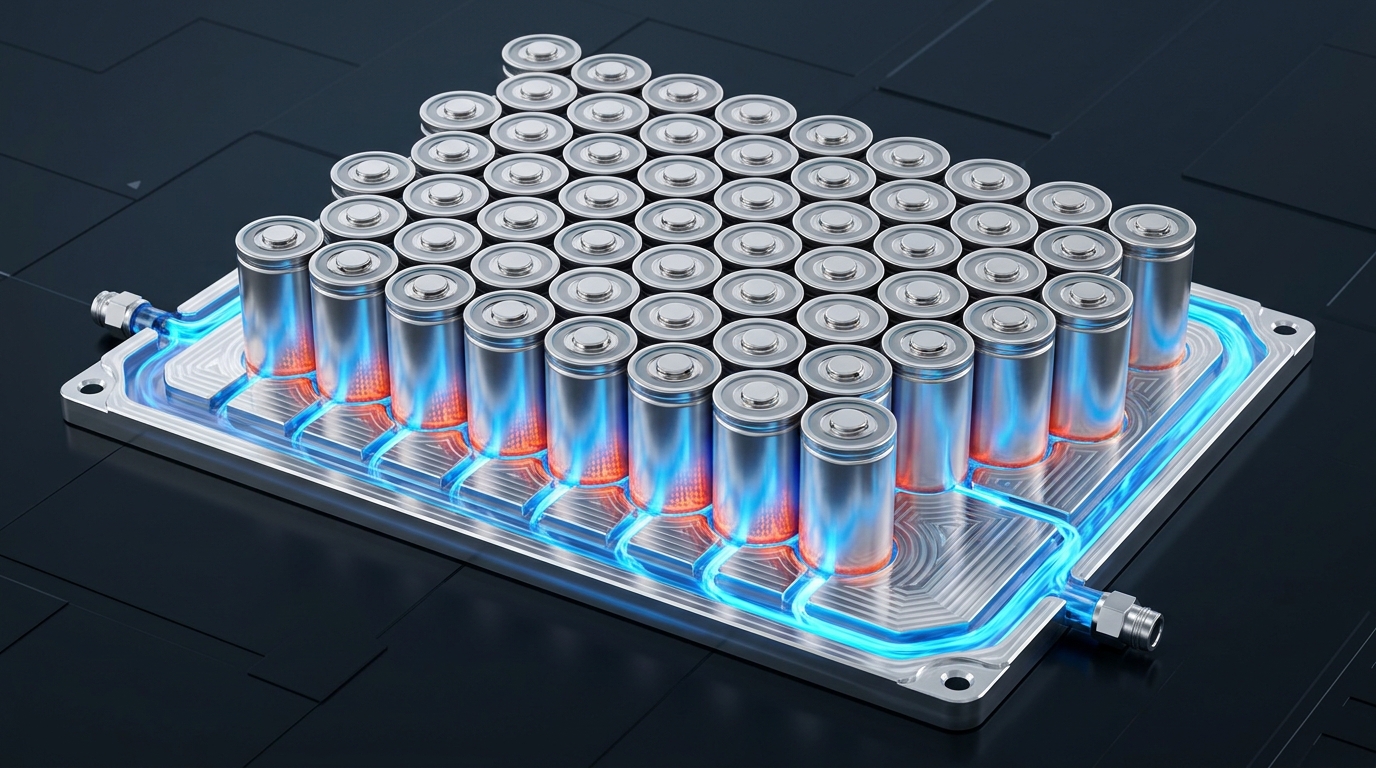
Figure 1: High-performance microchannel cold plate designed for 4680 cylindrical cell arrays, utilizing precision fluid routing to maximize thermal transfer while minimizing Z-height.
2. Preventing Thermal Runaway in 4680 and Large Cylindrical Cells
The 4680 cylindrical cell (46mm diameter, 80mm height) provides five times the energy capacity of traditional 2170 cells. However, its larger format introduces a significant thermal bottleneck: the increased radial distance from the cell core to the cooling surface.
If a single cell enters thermal runaway (reaching temperatures exceeding 600°C), the massive localized heat must be rapidly extracted to prevent propagation to adjacent cells—a catastrophic event known as thermal propagation.
Why Traditional Plates Fail: Standard stamped plates possess large, low-velocity macro-channels. Under peak thermal loads, the coolant flow becomes laminar, resulting in a low heat transfer coefficient (h) and a thick thermal boundary layer. They simply cannot absorb the intense heat spike fast enough.
The Microchannel Advantage: Ultra-thin microchannel cold plates employ precision-machined internal fin structures. These structures achieve three critical goals:
- Dramatically Increased Surface Area: The internal wetted area is multiplied by 3× to 5× compared to a hollow stamped tube.
- Turbulent Flow Induction: Micro-fins disrupt the boundary layer, forcing the coolant into turbulent flow (Reynolds Number Re > 4,000) and exponentially increasing the convective heat transfer coefficient.
- Targeted Impingement: Channels can be custom-routed to direct maximum coolant velocity precisely beneath the cell tabs or specific thermal hotspots.
3. The Manufacturing Challenge of the 1.2mm Limit
Reducing a liquid cooling plate's thickness to 1.2mm while maintaining internal fluid channels and structural integrity pushes the limits of modern metallurgy and fabrication.
The Problem with Stamping & Roll Bonding
Traditional roll bonding (inflating channels between two aluminum sheets) struggles below 2.0mm. The inflation pressure causes the thin walls to balloon, resulting in non-uniform channel heights, inconsistent contact resistance, and a high risk of bursting under system pressure spikes.
The Precision Vacuum Brazing Solution
To achieve a rigid, flat, and ultra-thin profile, Altus Precision utilizes advanced vacuum brazing.
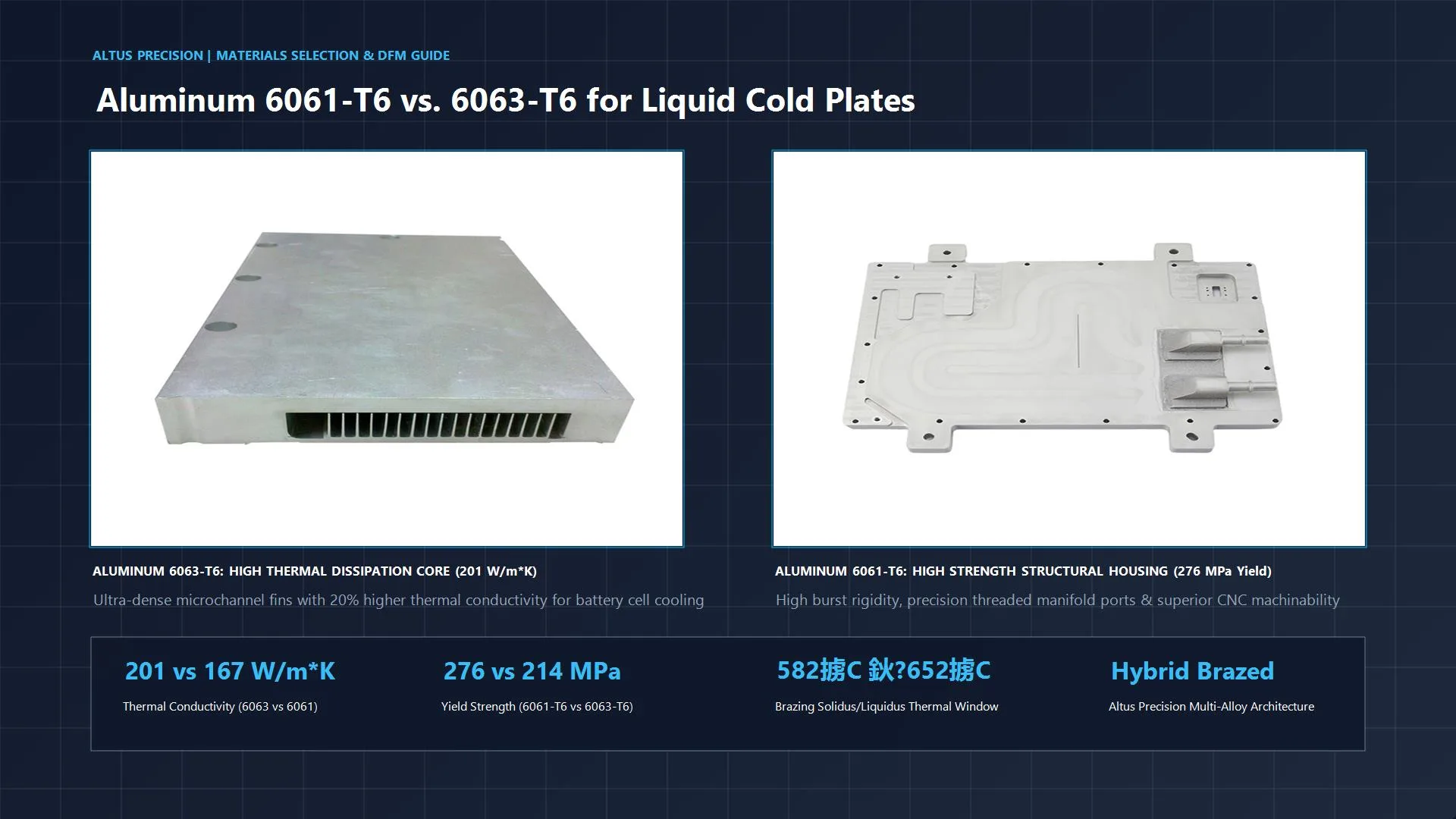
- Top and Bottom Sheets: High-strength Aluminum 3003 or 6061 sheets, milled down to 0.4mm - 0.6mm thickness.
- Internal Micro-Fin Core: A precisely corrugated or CNC-milled micro-fin layer is sandwiched between the sheets.
- Flux-Free Vacuum Brazing: The assembly is heated in a high-vacuum furnace (10-5 mbar). The clad brazing alloy melts and forms flawless metallurgical joints across every internal fin tip, fusing the three layers into a single, monolithic block.
This process yields a 1.2mm thick plate that is incredibly stiff, entirely flat (Ra < 0.2 μm contact surface), and perfectly hermetic.
4. Stamping/Blow-Molding vs. CNC Micro-Milling: Choosing the Right Path
When designing the internal flow paths, thermal engineers must evaluate the trade-offs between manufacturing methods.
| Feature | Stamping & Blow-Molding | CNC Micro-Milling (Solid Block) |
|---|---|---|
| Wall Thickness Limit | ~2.0mm - 2.5mm | As low as 0.3mm (wall) |
| Internal Fin Complexity | Simple macro-channels, low fin density | Complex micro-pillars, high-density fins |
| Pressure Drop (ΔP) | Low | Higher (Requires careful CFD optimization) |
| Tooling Cost | Very High (,000+) | Low to None |
| Ideal Application | Mass production of standard formats | High-performance, tight envelope, rapid prototyping |
For high-end performance vehicles, hypercars, and heavy-duty electric trucks where power density is the primary metric, CNC micro-milling combined with friction stir welding (FSW) or vacuum brazing is the only viable route to achieve the required thermal dissipation within the strict spatial envelope.
5. Automotive-Grade Burst and Shock Testing
A 1.2mm thick cold plate is entirely useless if it ruptures during a pothole impact or a coolant pressure spike. Automotive environments demand rigorous validation.
At Altus Precision, every ultra-thin cold plate design is subjected to the following mandatory validation protocol:
- Hydrostatic Burst Testing: Plates must withstand internal static pressures exceeding 4.0 MPa (40 bar) without structural failure or yielding.
- Pressure Pulsation Cycle: Simulating the vehicle's coolant pump start/stop cycles. The plate undergoes 100,000+ cycles from 0 to 1.5 MPa at high frequencies to validate fatigue strength.
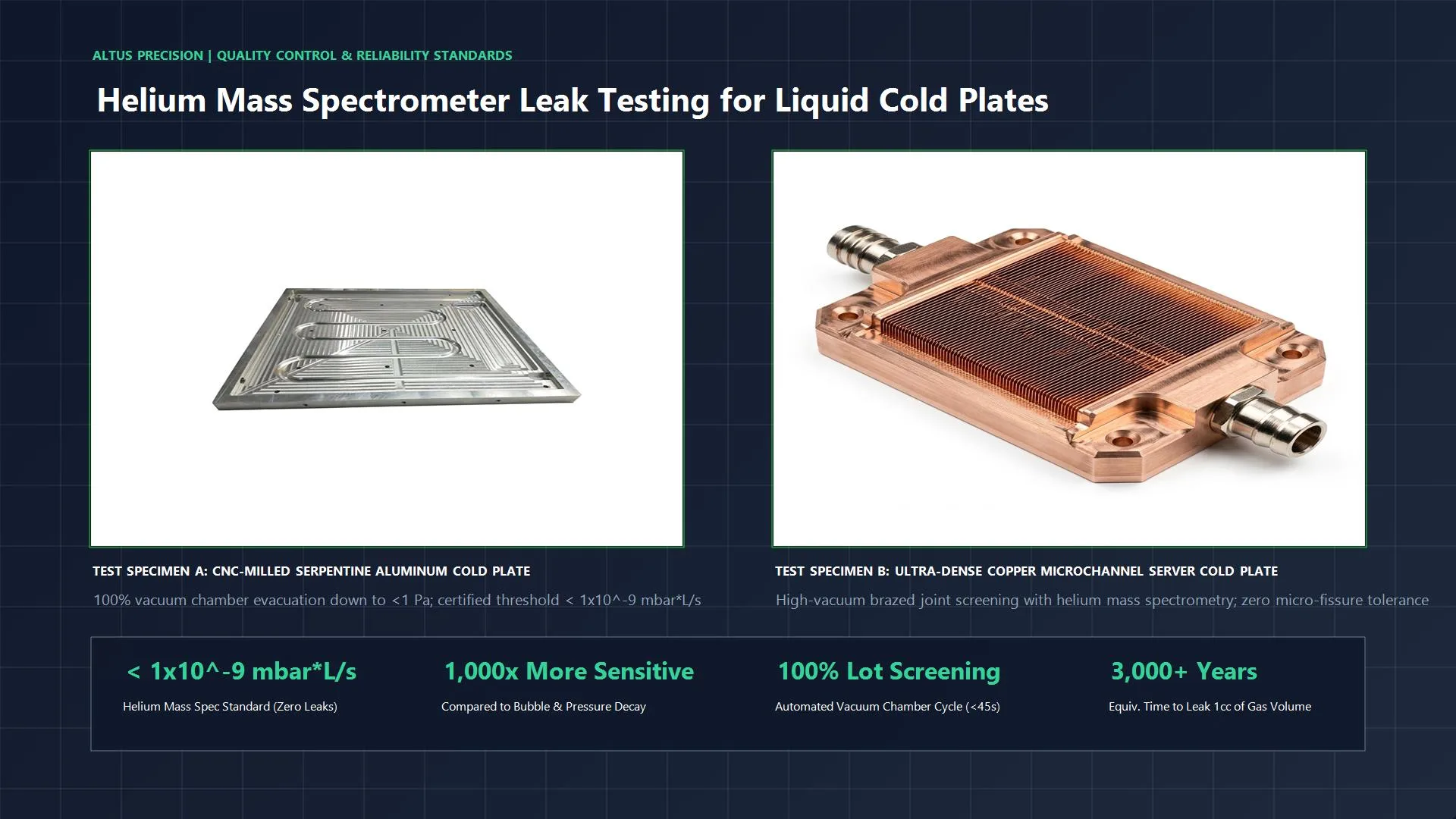
- Helium Mass Spectrometry (Hermeticity): Because liquid ingress into the high-voltage battery pack is an immediate safety hazard, every plate is vacuum-chamber tested using 4 tracer gas to certify a leak rate of < 1 × 10⁻⁹ mbar·L/s.
- Thermal Shock & Vibration: Subjected to rapid ambient swings (-40°C ↔ +85°C) while mounted on multi-axis shaker tables to simulate 10-year road vibration profiles.
6. Maximize Your Battery Pack Volumetric Efficiency with Altus Precision
Stop letting bulky, low-performance cooling infrastructure dictate your battery pack design.
By migrating to ultra-thin microchannel cold plates, thermal architects can reclaim crucial Z-height, prevent 4680 thermal propagation, and unlock faster charging curves for next-generation EVs.
Partner with Altus Precision to optimize your thermal envelope:
- Rapid Prototyping: CNC micro-machined prototypes delivered in weeks, not months.
- Advanced Joining: In-house vacuum brazing and Friction Stir Welding (FSW).
- Certified Quality: ISO 9001 and automotive-compliant testing protocols.
👉 Download the Altus Precision DFM Guidelines for EV Battery Liquid Cold Plates or submit your CAD models for a free engineering feasibility review today.
- Website: altusprecision.com
- Engineering Team: info@altusprecision.com
- Request a DFM Review: Upload CAD Drawings