4.2MPa Burst-Tested Aluminum Liquid Cold Plate for EV Battery Packs: A Manufacturing Case Study
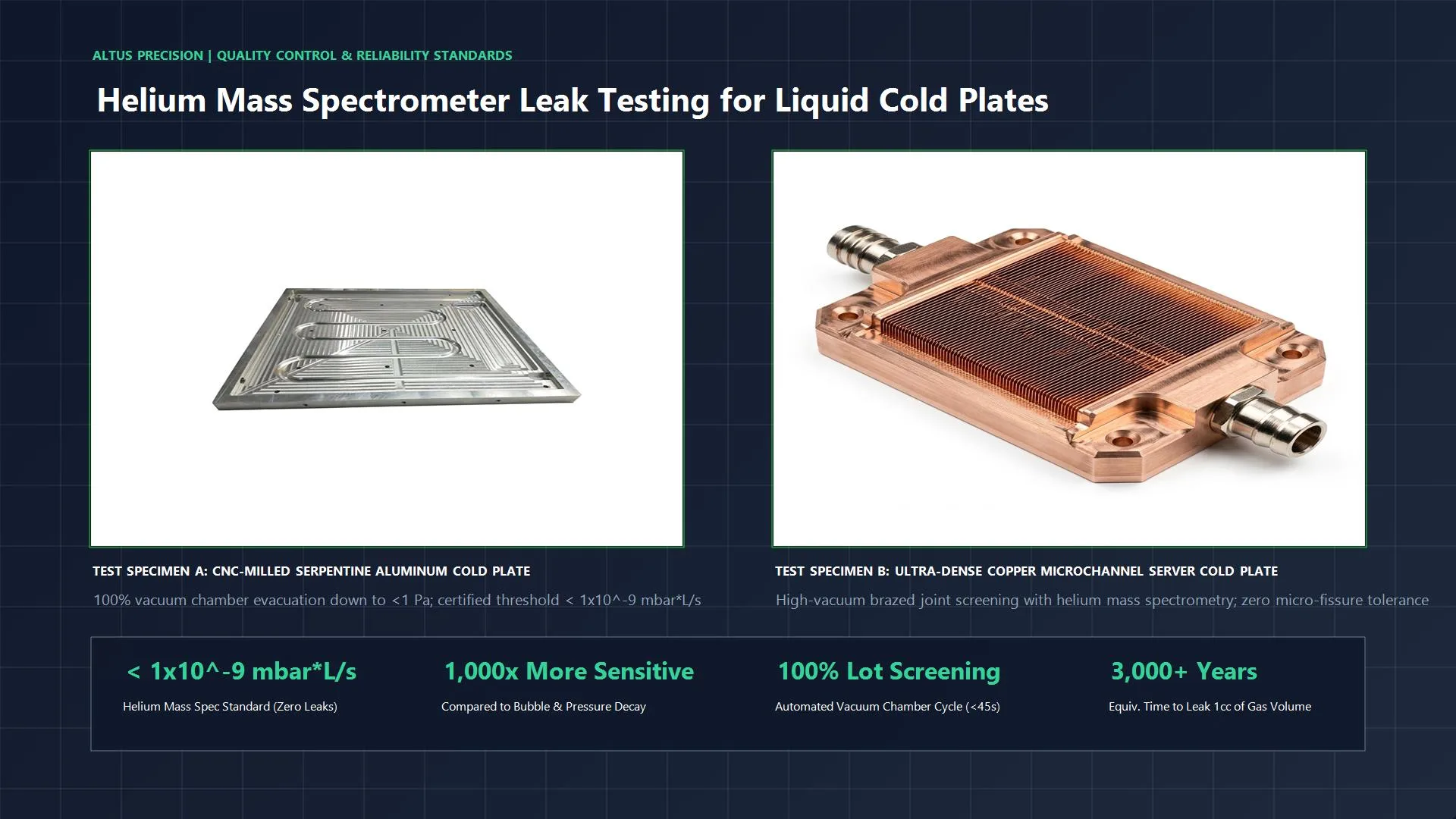
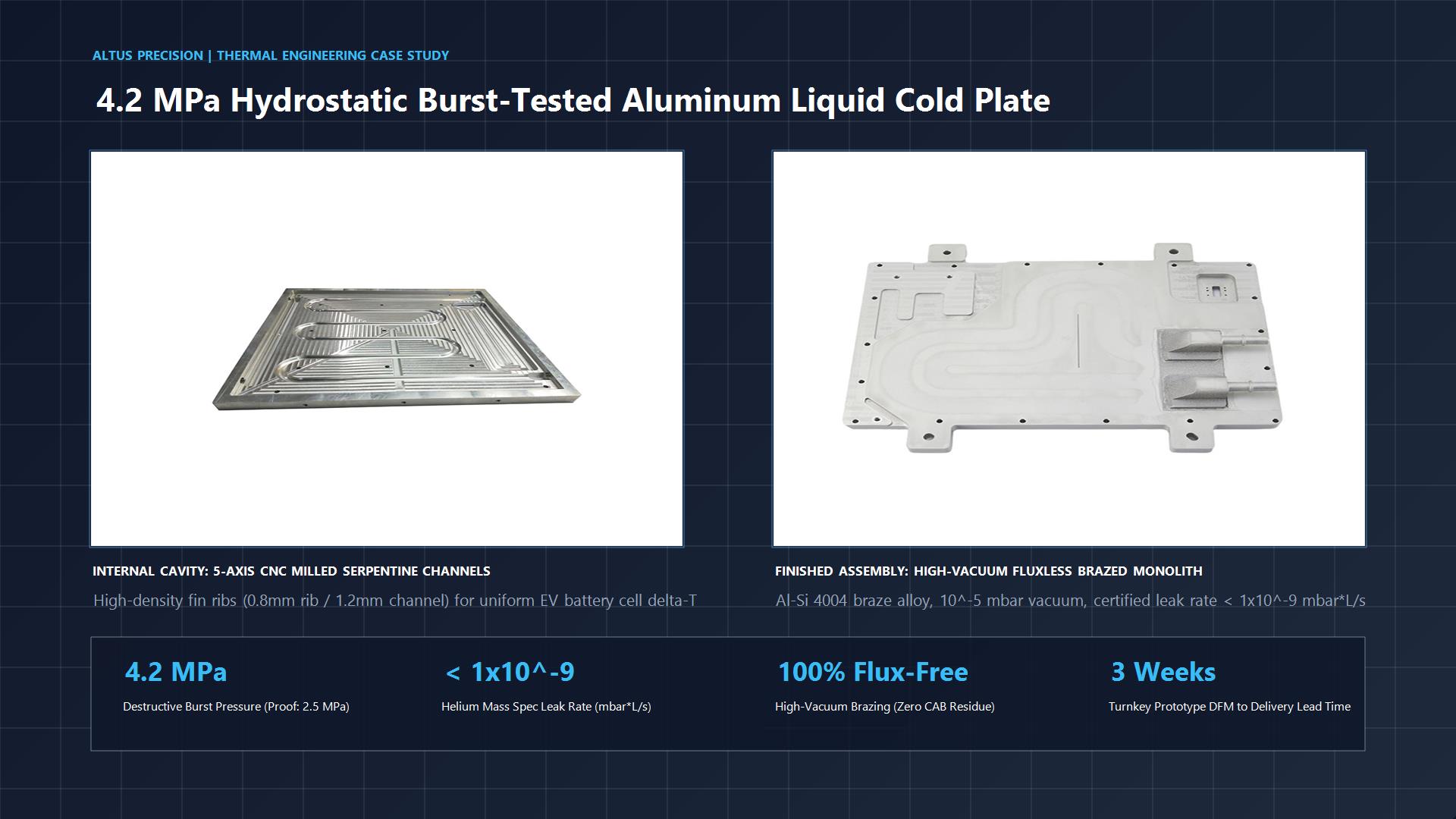
Executive Engineering Summary: In high-voltage commercial electric vehicle (EV) battery packs and heavy-duty electric commercial transport, catastrophic thermal runaway prevention mandates extreme liquid cooling integrity. This manufacturing case study documents how Altus Precision engineered, fabricated, and validated a custom vacuum brazed liquid cold plate for a Tier-1 North American commercial EV manufacturer. The application required an operating pressure of 1.5 MPa (15 bar), proof pressure of 2.5 MPa, and an uncompromising minimum destructive burst threshold of **4.2 MPa (42 bar / 609 psi)**âwhile maintaining zero internal flux contamination and strict coolant flow uniformity (Δ T < 2.5^°C across 192 prismatic battery cells). By combining 5-axis CNC-machined serpentine labyrinth micro-ribs in Al 6063-T6 with flux-free high-vacuum brazing at 10-5 mbar using Al-Si clad interlayers, Altus Precision achieved 100% monolithic joint integrity, helium leak tightness <1 × 10⁻⁹ mbar·L/s, and compressed prototype-to-delivery turnaround from 8 weeks to 3 weeks.
1. Project Background: The High-Pressure Commercial EV Battery Challenge
Commercial electric vehicles (Class 6â8 electric freight trucks, municipal transit buses, and high-duty mining haulers) operate under thermal and mechanical duty cycles vastly more punitive than passenger sedans:
- Ultra-High C-Rate Fast Charging (MCS 350kWâ1MW): Battery packs endure localized Joule heating rates exceeding 85 W per cell during continuous peak-power fast charging cycles.
- Strict Temperature Uniformity Limits: To prevent premature cell capacity degradation, inter-cell temperature variation across the entire multi-module tray must not exceed Δ T ≤ 2.5^°C-3.0^°C under peak thermal loads.
- Dynamic Hydraulic Shock & Pressure Surges: Coolant loops experience severe pressure spikes (water hammer, pump start-stop transients, and thermal expansion). While normal operating pressure is 1.5 MPa (15 bar), customer engineering specifications mandated a minimum destructive burst pressure rating of 4.2 MPa (42 bar / 609 psi).
- Zero Electrical Conductivity & Zero Sludge: Because the liquid cold plate sits directly beneath 800V high-voltage battery modules, internal coolant contamination by chemical brazing flux or metallic burrs can cause dielectric breakdown, localized galvanic corrosion, or fluid channel occlusion.
2. Why Conventional Manufacturing Processes Failed
Prior to partnering with Altus Precision, the client evaluated two conventional fabrication routes, both of which failed to clear automotive validation:
2.1 Failure Mode A: Controlled Atmosphere Brazing (CAB / Nocolok Flux)
Controlled atmosphere brazing using potassium fluoroaluminate flux is the automotive industry's traditional standard for radiators and heat exchangers. However, for a thick-walled, high-pressure cold plate with tight serpentine channels:
- Corrosive Residue Entrapment: Flux paste applied within internal blind flow channels cannot be completely rinsed out post-braze. Over 300 thermal shock cycles (-40^°C ≤ftrightarrow +85^°C), residual acidic flux leached into the ethylene glycol coolant, turning the fluid acidic (pH < 6.0) and inducing catastrophic pinhole pitting.
- Channel Starvation: Solidified flux clumps detached under turbulent fluid flow (Re > 4,000), migrating downstream and completely clogging three peripheral micro-channels, creating a lethal localized hot spot of +78^°C during 350kW fast-charging tests.
2.2 Failure Mode B: Friction Stir Welding (FSW)
Friction stir welding is a solid-state joining process commonly considered for aluminum cold plates. However:
- Internal Fin Aspect Ratio Restrictions: FSW requires massive downward forging tool pressure (10 kN-25 kN). To prevent collapsing internal cooling channels under the rotating shoulder tool, internal fin ribs had to be made unusually thick (>3.5 mm), severely reducing the effective heat transfer surface area.
- Root Flaw Weakness Under 4.0+ MPa Burst: Because FSW only bonds along the upper perimeter seams, internal channel partition ribs remained unbonded to the cover plate. Under destructive burst pressurization, hydraulic pressure caused the unbonded cover sheet to balloon outwardly like a diaphragm, tearing the weld root open at just 2.6 MPa to 2.9 MPa, well short of the mandatory 4.2 MPa specification.
CAB (Flux-Based) Brazing
- Flux Leaching: Residual flux dissolves into coolant, driving galvanic pitting.
- Clogging Risk: Sintered flux particles block micro-channels and starve battery cooling circuits.
- Burst Pressure: ~3.1 MPa (Inconsistent joint wetting due to flux voids).
Friction Stir Welding (FSW)
- Internal Ribs Unbonded: Top cover balloons under hydraulic load because internal ribs cannot be welded.
- Thermal Surface Penalty: Ribs must be oversized (>3.5mm) to withstand tool plunge forces.
- Burst Pressure: 2.6 â 2.9 MPa (Root fatigue failure under dynamic pulses).
High-Vacuum Fluxless Brazing
- 100% Monolithic Bonding: Every internal rib and external flange bonds simultaneously.
- Zero Flux Residue: 10â»âµ mbar high-vacuum atmosphere; pure Al-Si eutectic bond.
- Burst Pressure: 4.2 â 4.8 MPa Verified (Rupture occurs in base metal, not joint).
3. Engineering Solution: Metallurgy & 5-Axis CNC Labyrinth Design
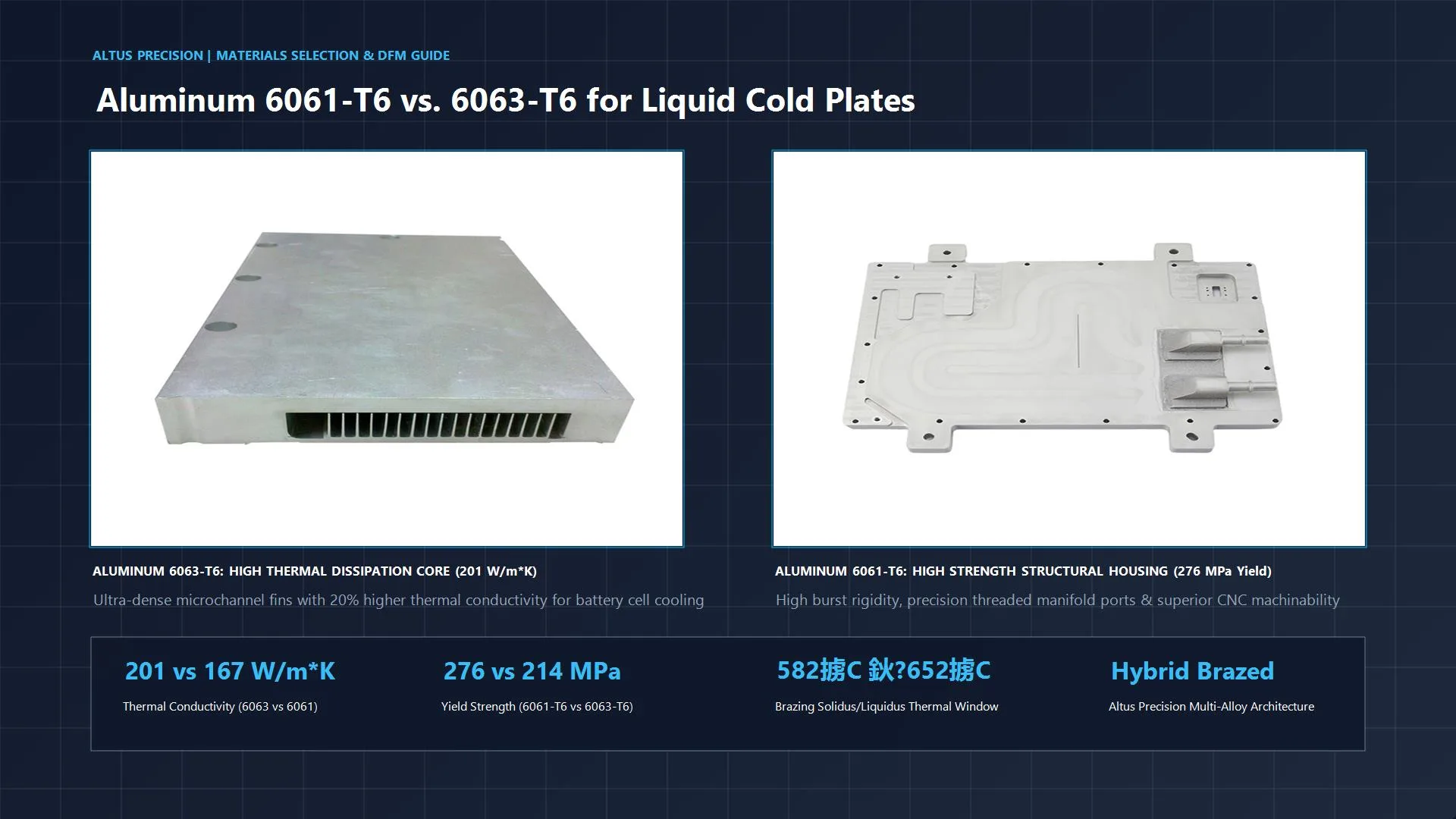
To achieve both high burst pressure and uniform heat transfer, Altus Precision re-architected the cold plate into a two-piece precision assembly: an Al 6063-T6 CNC-milled base cavity plate paired with an Al 3003-H14 clad cover sheet.
3.1 Material Selection Rationale
- Base Plate: Al 6063-T6 Extruded Plate
- Thermal conductivity: λ ≈ 201 W/(m·K).
- Yield strength: σy ≥ 210 MPa; Tensile strength: σu ≥ 245 MPa.
- Al 6063 offers superior mechanical strength and post-braze precipitation hardening capability compared to 1000-series aluminum, ensuring that internal fin walls do not buckle or creep under severe cyclic pressure pulses (0 → 1.5 MPa at 2 Hz).
- Cover Plate & Braze Alloy: Al 3003 Clad with 4004 (Al-Si10-Mg1.5)
- Core: Al 3003-H14 with high corrosion resistance in aqueous glycol environments.
- Cladding Layer: Both sides clad with 8%-10% thickness of 4004 braze alloy (solidus 555^°C, liquidus 592^°C). The magnesium content (1.0%-1.5%) acts as an internal vapor-phase getter during vacuum heating, breaking down the stubborn native aluminum oxide (Al2O3) film without requiring any corrosive chemical fluxes.
3.2 5-Axis CNC Micro-Milling of Serpentine Labyrinth Channels
Rather than simple straight channels, Altus Precision designed an optimized dual-inlet, serpentine counter-flow architecture:
- Fin Width: 0.85 mm pm 0.02 mm
- Channel Width: 1.20 mm pm 0.02 mm
- Channel Depth: 4.20 mm (Aspect Ratio: ~3.5:1)
- Top Sealing Land Width: 1.80 mm wide continuous contact lands along every internal channel divider rib, providing over 120 cm2 of total vacuum-brazed structural joint surface area across the cold plate.
This high structural bonding surface area effectively ties the top cover plate to the bottom base at over 40 distinct continuous linear ribs, transforming the plate into a multi-webbed box girder that distributes hydraulic pressure tensile stresses evenly across hundreds of monolithic joints.
4. The High-Vacuum Fluxless Brazing Process
The defining factor in achieving a 4.2 MPa burst rating lies in the precision control of the High-Vacuum Brazing (HVB) thermal cycle.
4.1 Surface Pre-Treatment: Ultrasonic Precision De-Oxidation
Before loading into the vacuum furnace, all aluminum components undergo a strictly timed 4-stage chemical cleaning sequence:
- Alkaline degreasing in an automated ultrasonic bath (60^°C, 40 kHz) to eliminate all hydrocarbon residues and machining coolants.
- De-ionized water cascade rinse (18 MΩ·cm).
- Controlled acid deoxidizing pickle in nitric-hydrofluoric bath to strip the native oxide layer and produce a uniform, sub-nanometer oxide profile.
- Hot cleanroom air dry (80^°C, ISO Class 7 cleanroom environment). Parts are assembled with high-temperature molybdenum-spring clamping fixtures within a mandatory 4-hour assembly window.
5. Destructive Testing & Quality Assurance: The 4.2MPa Burst Verification
To certify the cold plate for the client's Tier-1 vehicle platform, Altus Precision subjected random sample units from every production lot to a destructive hydraulic pressure ramp test in our specialized burst test containment cell.
5.1 Destructive Burst Test Procedure
- The cold plate is instrumented with high-precision strain gauges across the top cover plate center and fluid inlet/outlet manifolds.
- The internal volume is completely purged of air and backfilled with calibrated hydraulic testing oil (viscosity 32 cSt).
- A closed-loop servo-hydraulic pump ramps pressure at a controlled rate of 0.1 MPa/s:
- Hold Point 1 (1.5 MPa / 15 bar - Operating): 10-minute hold. Zero pressure loss; maximum center deflection: <0.03 mm.
- Hold Point 2 (2.5 MPa / 25 bar - Proof): 30-minute hold. Zero pressure drop; zero permanent plastic deformation after depressurization.
- Destructive Ramp (>2.5 MPa → Burst): Continued pressure ramp until physical loss of fluid containment.
5.2 Failure Analysis: Monolithic Joint Superiority
When the cold plate finally reached physical rupture at **4.65 MPa (46.5 bar / 674 psi)**âwell above the customer's 4.2 MPa requirementâpost-mortem forensic examination revealed a remarkable finding:
Key Forensic Finding: Not a single vacuum-brazed seam or channel dividing rib experienced joint debonding or peeling. Instead, failure occurred via ductile tensile wall thinning and shear rupture of the Al 3003 base metal plate adjacent to an external mounting boss. This definitively proved that the vacuum-brazed joint shear strength exceeded the ultimate tensile strength (UTS) of the parent aluminum alloy, delivering a true monolithic heat exchanger.
6. Metallographic Cross-Section & Joint Void Verification
Following destructive burst testing, sample cross-sections were cut via precision diamond-wheel wire EDM, mounted in epoxy, polished down to 0.05 μm colloidal silica, and examined under scanning electron microscopy (SEM) and optical metallography:
- Fillet Formation: Symmetrical, smooth concave fillets formed along every internal channel partition rib with a continuous contact angle <25^°, completely eliminating mechanical notch stress concentrations.
- Joint Void Ratio: Ultrasonic scanning (C-SAM) and SEM image analysis confirmed an aggregate void ratio <1.8%, vastly superior to the automotive industry standard allowance of <10%-15%.
- Intermetallic Boundary: Complete metallurgical coalescence between the Al-Si braze filler and Al 6063 grain boundaries without micro-cracks, hydrogen blisters, or oxide inclusions.
7. Supply Chain Acceleration: Compressing Turnaround from 8 Weeks to 3 Weeks
In the fast-moving EV sector, time-to-market is critical. Traditional tier-1 cooling suppliers quoted the client 8 to 10 weeks for prototype tooling and initial sample fabrication due to reliance on external CAB brazing subcontractors and dedicated stamped dies.
Altus Precision deployed our agile Turnkey Precision Thermal DFM Framework:
- Elimination of Hard Tooling: By utilizing multi-spindle high-speed 5-axis CNC micro-milling directly from solid billet/extrusion, we bypassed the 4-week hard stamping die lead time entirely while allowing rapid channel geometry iteration.
- In-House High-Vacuum Furnaces: All vacuum brazing, thermal cycling, and nitrogen quench cycles were executed in-house at Altus Precision, eliminating subcontractor transit delays and quality finger-pointing.
- Integrated Helium Mass Spectrometer Testing: Every single prototype unit underwent automated vacuum-chamber helium sniffing before customer shipment, guaranteeing zero out-of-box defects.
8. Frequently Asked Questions (FAQ)
Q1: What is the primary advantage of vacuum brazing over friction stir welding (FSW) for liquid cold plates?
Answer: Friction stir welding only seals the outer perimeter of the plate; it cannot bond internal serpentine partition ribs without crushing them under the rotating tool shoulder. Under high hydraulic pressures (>2.5 MPa), unbonded FSW covers balloon outward and rupture along the weld root. In contrast, vacuum brazing achieves 100% metallurgical bonding across every single internal rib and perimeter seam simultaneously, transforming the cold plate into a rigid, monolithic honeycomb structure capable of withstanding burst pressures >4.2 MPa.
Q2: Why is flux-free brazing essential for battery thermal management systems (BTMS)?
Answer: In battery cooling loops, even parts-per-million traces of corrosive fluoride or chloride residues from chemical fluxes (like Nocolok) leach into the water-ethylene glycol coolant over time. This decreases coolant resistivity, increases the risk of high-voltage electrical shorts, and triggers localized galvanic pitting in thin channel walls. Altus Precision's high-vacuum fluxless brazing operates at 10-5 mbar using magnesium vapor deoxidation, leaving zero chemical residue inside internal channels.
Q3: How do you maintain flatness and prevent thermal warpage during vacuum brazing?
Answer: Aluminum has a high coefficient of thermal expansion (≈ 23 × 10-6/K), making large-format battery cold plates prone to warping during 590^°C heating. We mitigate thermal warpage through precision-machined graphite and molybdenum-spring clamping fixtures that apply uniform, self-compensating planar pressure throughout the thermal expansion and solidification cycle. Post-braze base plate flatness is maintained within <0.20 mm across a 600mm span, guaranteeing tight thermal interface contact with battery cell modules.
Q4: Can Altus Precision scale from rapid prototyping to tens of thousands of production units?
Answer: Yes. Our facility operates multi-chamber high-vacuum production furnaces with batch capacities exceeding 50 to 120 large-format cold plates per run, supported by automated robotic CNC milling cells and multi-axis CMM inspection stations. We support engineering programs from Initial Article Inspection (FAI) prototypes up to multi-thousand automotive-grade production volumes under ISO 9001 quality management systems.
9. Accelerate Your High-Pressure Liquid Cooling Development
Are you developing liquid cooling cold plates for commercial EV battery packs, high-voltage traction inverters, or multi-megawatt energy storage systems (BESS)? Do not compromise on burst pressure safety or tolerate corrosive chemical fluxes.
Altus Precision Delivers:
- Verified High-Pressure Reliability: Burst ratings certified up to 4.2 MPa-5.0 MPa.
- 100% Flux-Free High-Vacuum Brazing: Zero internal chemical contamination.
- Complete Nondestructive Testing: Vacuum-chamber Helium Mass Spectrometry (<1× 10⁻⁹ mbar·L/s) and CMM dimensional certification.
- Fast-Track Turnaround: Rapid prototype samples delivered in as fast as 3 weeks.
ð Submit your CAD files today for an engineering DFM evaluation and sanitized test report:
- Website: altusprecision.com
- Direct Engineering Contact:
info@altusprecision.com - Request Cold Plate DFM & Quote: Upload 3D CAD (STEP / IGES)